Software Tool Articles: new opportunities for researchers and software engineers
| 31 August, 2022 | Abbie nicholson |

In this blog, we outline what a Software Tool Article is and how publishing one could lead to increased recognition and improve the visibility and impact of your research. We also talk to HRB Open Research author, Lydia King PhD about how her software tool could potentially improve cancer patient outcomes.
Discover how publishing one of these articles can help you get the credit you deserve and support reproducibility in research.
Algorithms, code, and software tools are crucial to the discovery process in every field of research, including healthcare delivery and clinical research. Yet, this valuable article type can often go unrecognized. A software tool might get mentioned in the methods section of a research article, or researchers may include a link to the software in the footnotes of a research paper. But is that enough?
HRB Open Research believes that all research outputs deserve proper recognition, including software tools. That’s why we publish many article types, from traditional Research Articles to less common formats such as Software Tool Articles, Data Notes, and beyond.
We also know that reproducibility is the cornerstone of robust, trustworthy research. But so much published research is not reproducible simply because authors haven’t fully shared the tools they used in their research. This includes the software they created as part of their work. Software Tool Articles aim to tackle this problem.
What is a Software Tool Article?
Software Tool Articles are research outputs that enable researchers and software engineers to describe their research software or tools developed from existing software. They cover:
- Why you developed the software
- Details of the code, method, and analysis used
- Examples of data input sets
- Examples of outputs and how to interpret these
- Tips on how to maximize the tool’s potential
Let’s look at an example of a recently published and peer reviewed Software Tool Article.
GNOSIS: an R Shiny app supporting cancer genomics survival analysis with cBioPortal
Authors: Lydia King, Andrew Flaus, Simone Coughlan, Emma Holian, Aaron Golden
This Software Tool Article illustrates how GNOSIS: an R Shiny app supports clinician-researchers by helping them explore and visualize clinical and genomic data.
Typically, cancer genomics data is curated and held in repositories like cBioPortal, where users need advanced programming skills and expertise to analyze the data in a meaningful way. This is problematic because if a clinician-researcher wants to investigate cancer genome data they first need to obtain this additional expertise. This halts discoveries that could positively affect patient outcomes.
GNOSIS simplifies the process of analyzing cancer genomic data in two key ways:
#1 Intuitive interface to aid data analysis
GNOSIS provides an intuitive graphical user interface and multiple tab panels. This allows clinician-researchers to perform a range of functions, including:
- Data upload and initial exploration
- Data visualizations
- Statistical analysis
#2 Downloadable resources to help develop computing skills
GNOSIS also facilitates reproducible research by providing downloadable logs and scripts from each session. This offers an excellent means of supporting clinician-researchers in developing their statistical computing skills.
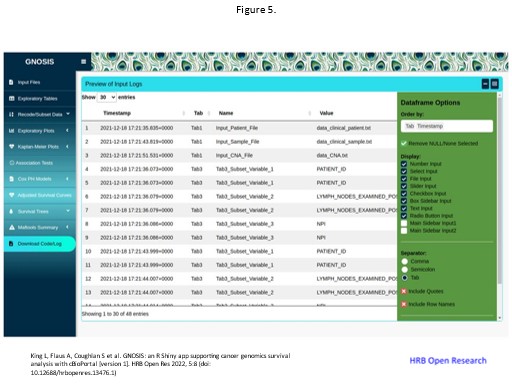
By helping clinician-researchers develop statistical computing skills and visualize cancer genomic data, they can better identify patients with a greater risk of lethal disease. This could lead to improved access to care, treatment, and patient outcomes.
We spoke with Lydia King to learn more about GNOSIS: an R Shiny app.
Please tell us a little about yourself and your field of research.
I obtained a BSc in Biology and Statistics from Maynooth University and pursued an MSc in Biomedical Genomics at the University of Galway. I’m a third year PhD student at the SFI Centre for Research Training in Genomics Data Science, at the University of Galway, supervised by Dr. Emma Holian.
What is GNOSIS: an R Shiny app, and what inspired you to develop it?
GNOSIS is an R Shiny app that allows users to efficiently explore and visualize clinical and genomic data obtained from cBioPortal or other cancer genome repositories. Based on a reactive programming model, Shiny behaves similarly to a spreadsheet and helps users build interactive web applications (apps). Despite cBioPortal being a valuable tool for exploring large-scale cancer genomic data sets, it became clear there is a lack of tools available to run robust analysis on data obtained from cBioPortal. So, although I developed GNOSIS with my specific needs in mind, it has evolved and allows users to run various analyses.
How will this software help clinician-researchers?
There are various challenges that clinician-researchers face when exploring clinical and genomic data. These include the need to have some programming experience to effectively analyze the data, the knowledge of statistical tests to interpret results accurately, and the ability to carry out reproducible work.
GNOSIS helps clinician-researchers by providing an easy-to-use, point-and-click graphical user interface. This interface removes the need for any programming experience and allows researchers from all backgrounds to analyze their data efficiently. Moreover, GNOSIS logs all user activity and lets users download the code from each session to develop their statistical computing skills and facilitate reproducibility. GNOSIS also points users to various resources, usually websites, explaining when to use certain statistical tests and how to interpret the results. This allows users to run appropriate tests for the data in question while also acting as an educational tool.
What is the potential impact of GNOSIS?
GNOSIS provides clinician-researchers with a simple, fast, and efficient way to analyze both clinical and genomic data. As a result, GNOSIS has the potential to impact cancer patients by enabling researchers to make discoveries, particularly for potential biomarkers.
What are the next steps?
The great thing about GNOSIS is that it’s open source. This means that there is ample opportunity to enhance and develop the functionality of GNOSIS either by myself, through collaboration, or even by independent third parties.
The next step for me is to discover areas of research where the availability of easy-to-use, open-source apps would make a meaningful difference. I also hope to collaborate with other researchers developing these types of apps working in the personalized medicine community.
Why did you decide to share your code and data?
Sharing all aspects of GNOSIS, including the code, the data utilized throughout, and the instructional videos, was an easy decision to make. I created GNOSIS with ease of use and reproducibility in mind. As such, providing users with ample information about the app’s aims, the data used to get the results, and instructions for ease of use was vital.
In addition, by sharing this information, it is clear to users what GNOSIS is capable of, what questions it could answer, and, if needed, how it could be modified to fit the needs of others.
What advice would you give to others interested in sharing their data or code openly?
Having well-documented code will help readers understand quickly what your code does and it will also help futureproof you when you come back to look at code you wrote months ago.
Why should I publish a Software Tool Article with HRB Open Research?
Publishing your Software Tool Article with HRB Open Research will help you get the credit you deserve and increase the discoverability of your research.
Software Tool Articles are fully citable and undergo peer review, meaning you can get recognition for all your research outputs. Furthermore, once your paper has passed peer review, it will benefit from increased visibility, reach, and impact through indexing in PubMed and Scopus.
Interested in learning more about Software Tool Articles? Explore our guidance for authors to get started.