Separating fact from fiction: 5 open research myths
| 23 August, 2023 | Abbie nicholson |

For some researchers, open research is still a new concept and can be a source of confusion or apprehension. From open data and data sharing to open peer review and research impact, there are many open research myths across the research community.
In our blog, we hope to set the record straight on some of these myths and separate the fact from the fiction, helping all researchers to understand the benefit of open research to them and their community.
First up: what is open research?
Before we delve into these open research myths, it’s worth defining what we actually mean by ‘open research’.
‘Open research’ is often used interchangeably with ‘open science’ and is a practice that aims to open up access to all parts of the research process. This includes both products of the research itself and later stages of research dissemination, such as peer review.
There are many facets to open research, including:
- Open access – publishing work in a venue that provides immediate, permanent, and free access.
- Open data – providing details about and access to underlying data.
- Open peer review – making all peer reviewer identities, reports, and comments openly available alongside the article.
- Publishing all outputs – placing equal value on all research outputs rather than just the final Research Article.
So, let’s separate the fact from the fiction for some of these elements.
Myth #1 ‘Open peer review lacks rigour’
One of the main arguments against an open peer review model is the perception that it is not as rigorous as closed reviews. This often stems from the idea that reviewers will hold back on their feedback because it is available for everyone to see and access.
However, studies have found that open peer review actually results in more valuable feedback for authors. Reviewer names and comments being openly available increases reviewer accountability and reduces the potential for bias or conflict of interest, which helps to uphold the integrity of the process.
As a result, reviewers often provide a more considered, constructive review with helpful suggestions for improvements.
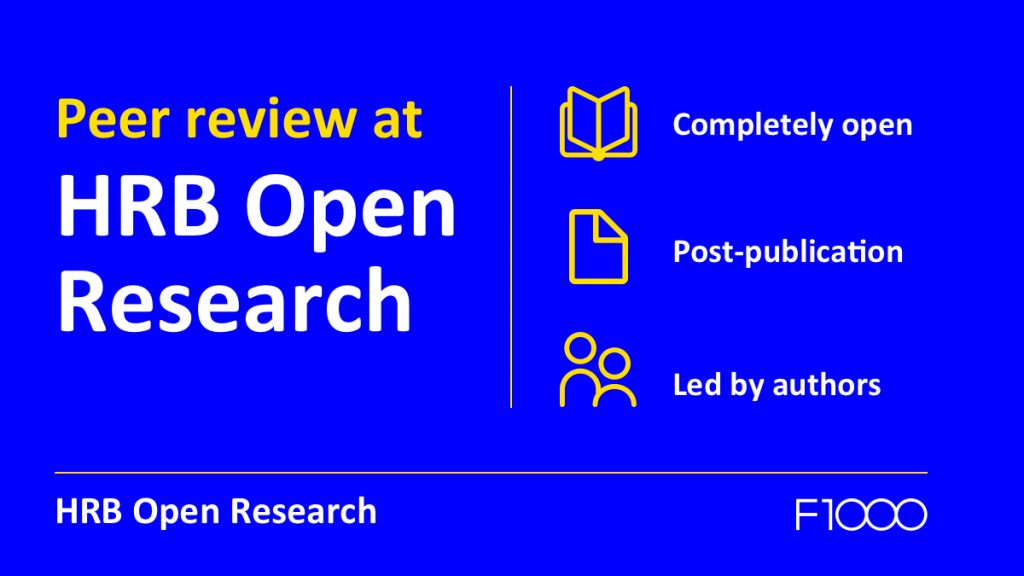
HRB Open Research operates an open peer review model that also requires that all reviewers meet certain criteria to be eligible, which ensures a rigorous peer review process.
Myth #2 ‘Open access venues lacks editorial standards’
Along similar lines to myth #1, many researchers are concerned that open access publishing venues do not have the same level of editorial standards as paywalled counterparts.
While there are some open access venues where that may be the case, the same can also be said for paywalled venues, and this is not only limited to open access.
When considering any journal, whether open access or not, it’s important to understand the editorial policies in place and whether this aligns with your personal values. While not all publishers will make these available, that can sometimes be a telling point in itself.
At HRB Open Research, for example, we clearly outline our editorial policies and have a professional team of editors who review all submissions to ensure they align with these policies before accepting them for publication.
Checks include:
- Author criteria
- Originality
- Language and readability
- Methods
- Data availability
- Ethics compliance
All of this ensures a rigorous editorial standard for the platform and its publications.
Myth #3 ‘Only venues with Impact Factors are worth considering’
It is a long-standing view in publishing and the wider academic community that research value is determined by the journal in which it is published, most notably, journals with high Impact Factors.
However, this can distort the actual value of the research, and one of the key tenets of open research is reforming how we view and assess research impact.
This includes moving away from journal-level metrics like Impact Factors to the responsible use of article-level metrics, such as downloads, views, and citations, as well as a more holistic view of researcher activities, such as participating in peer review.
Find out more about research assessment reform and open research principles in our blog.
HRB Open Research does not have an Impact Factor for exactly these reasons. Instead, we focus on promoting the responsible use of article-level metrics, such as article views and citations, as well as providing other opportunities for research impact such as participating in peer review. Additionally, our open access model can help authors to reach a wide audience and boost the real-world impact of their work.
Myth #4 ‘Open data is impossible in health and social care research’
One of the most common open research misconceptions for health and social care researchers specifically is around data sharing and open data.
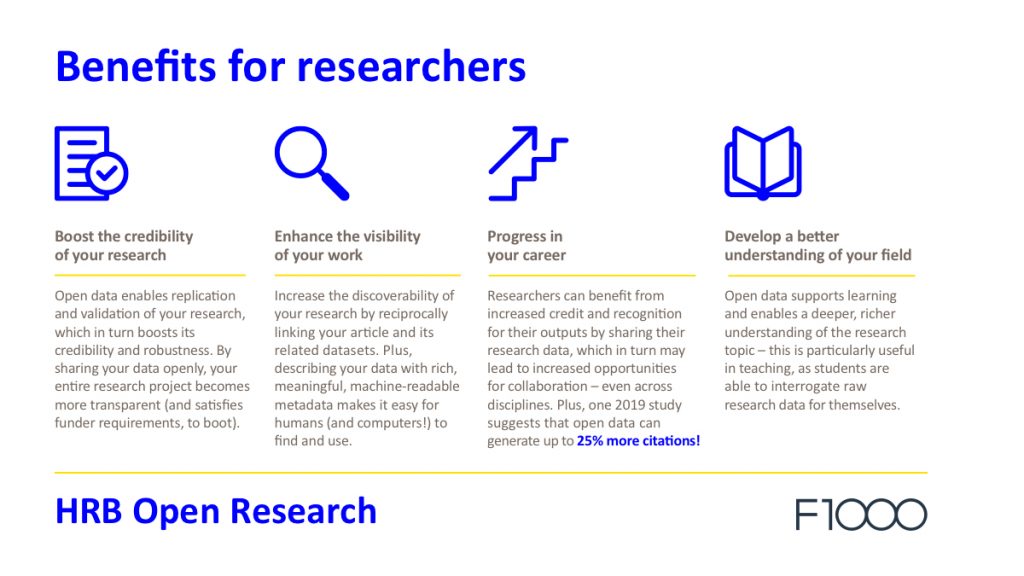
The concept of providing access to all underlying data is a key element of open research, helping to improve reproducibility, reduce research waste and inefficiencies, save costs, and boost trust in findings.
However, when dealing with sensitive or third-party data, this can seem impossible. We explored why this isn’t the case in our blog, with six safeguarding measures to help share data openly and safely:
- Understand ethical and legal requirements
- Create a Data Management Plan
- Gain appropriate consent
- Anonymise data
- Control data access
- Publish metadata instead of raw data
You can also learn more about the benefits of publishing your data as a Data Note.
Myth #5 ‘I should focus on publishing a Research Article because this is the most important output’
Finally, many researchers still feel that the pinnacle of any study is the publication of a Research Article. However, while Research Articles continue to play a key role, this view can undermine the importance of many other research outputs that are often sidelined in the final publication.
Open research is committed to opening up all parts of the research process, including earlier project stages such as literature reviews, methods, and research notes, and all underlying materials such as data (as we discussed earlier) and software.
Publishing these outputs as their own standalone articles is key for researchers and the wider academic community for many reasons, including:
- Reducing research waste
- Enabling more in-depth analysis and feedback
- Improving reproducibility and trust in findings
- Increasing research visibility, capacity for citations, and real-world impact
We explored the importance of publishing diverse article types in our blog.
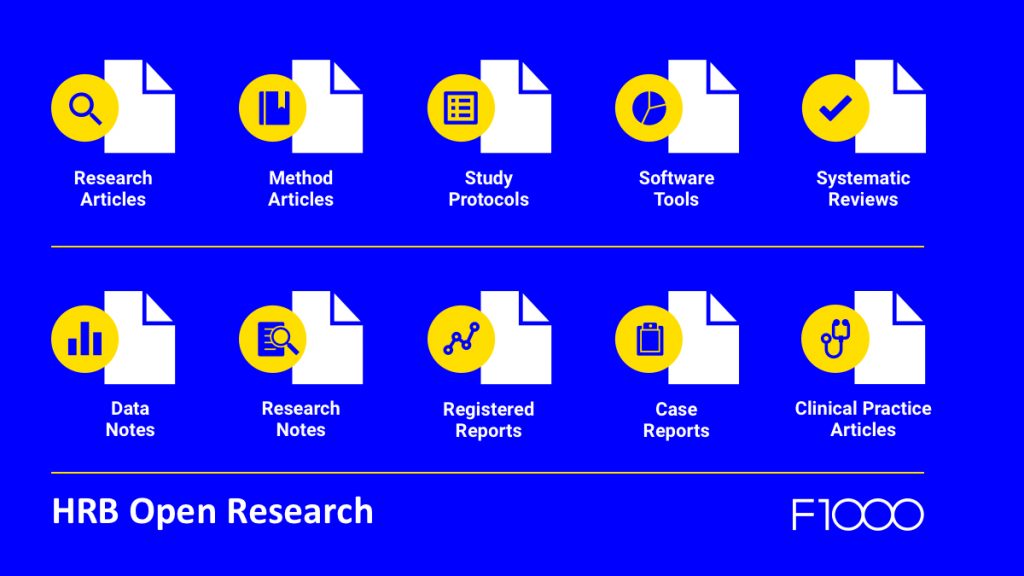
To support the HRB research community in this, HRB Open Research accepts 10 different article types as publications, helping researchers to publish their work at every stage of their project.
Publish your HRB-funded work open access
HRB Open Research is an open access venue dedicated to publishing all outputs stemming from HRB-funded research.
With no author-facing fees, thousands of HRB grantees are already publishing with us today.
Find out more about publishing your own work and becoming part of the open research movement.