Maximising research outputs: publishing findings at the data collection and analysis stages
| 17 April, 2023 | Abbie nicholson |

In order to maximise research outputs and reduce research waste, we believe it’s key for researchers to be able to publish their findings at every stage of the research project, from concept through to final analysis.
That’s why HRB Open Research supports 11 different article types, from traditional outputs like Research Articles and Registered Reports to non-traditional outputs such as Software Tool Articles and Data Notes.
We explored the importance of diverse article types for researchers in the first blog of the series, while in the second, we explored the different article types that can be published at the concept and planning stages of a project.
In this final blog of the series, we’re looking at the data collection and analysis phase of a study and the different publishable article types for each.
Data Collection stage
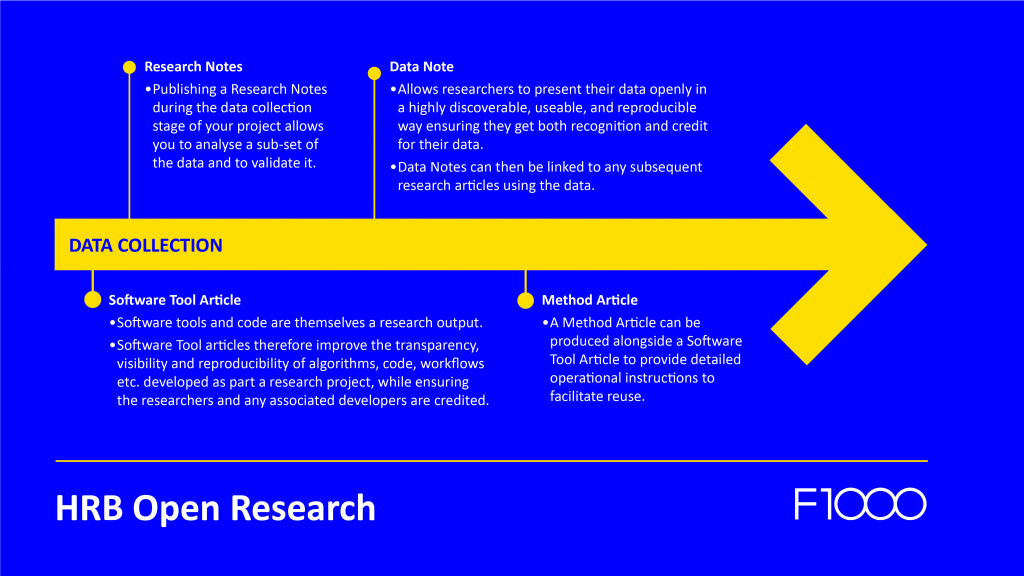
As a research project progresses to the data collection stages, there are several outputs that can be published.
Method Articles
Method Articles can be published at different stages of the research journey, and during planning, they can be used to outline initial methods.
In data collection, they can highlight changes to these initial methods, including issues, refinements, new methods, and more. This ensures each publication builds on its predecessor to reflect the evolving nature of the project.
At this stage, Method Articles also allow authors to produce detailed operational instructions of methods. When published alongside Data Notes and Software Tool Articles, these can help improve the reproducibility of results for other authors and provide a rich resource for future studies.
Previously published Method Articles:
- Data linkage in medical science using the resource description framework: the AVERT model
- Linking death registration and survey data: Procedures and cohort profile for The Irish Longitudinal Study on Ageing (TILDA)
Research Notes
Like Method Articles, Research Notes can be published across a full research project.
During planning stages, Research Notes can provide a space to highlight preliminary outputs and small findings that would normally be missing from the final Research Article.
They can play a similar role during data collection, providing an opportunity to share a sub-set of data that would typically be excluded from the final article due to space constraints, and ensuring this work is still visible and citable by the wider research community.
Previously published Research Notes:
- Acceptability and feasibility of conducting a pilot trial in Irish primary care: lessons from the IDEAs study
- Understanding the uptake of a national retinopathy screening programme: An audit of people with diabetes in two large primary care centres
Data Notes
Open data is a key element of open research practices and central to HRB Open Research’s goal to make research fully transparent and reproducible. We support the FAIR Data principles, which require data to be findable, accessible, interoperable, and reusable. Data Notes are one of the primary article types to support this.
Rather than presenting data in just a section of the final Research Article, which may not always meet FAIR data guidelines or effectively promote reproducibility and reuse, Data Notes allow researchers to present their data in a format specifically designed for this output.
Data Notes provide brief descriptions of datasets, as well as details of why and how the data were created and can then be linked to any subsequent publications using the data.
By providing another citable and reusable publication alongside the usual Research Article, authors can:
- Meet FAIR guidelines
- Ensure full transparency and reproducibility of data
- Potentially boost research visibility
Previously published Data Notes:
- Maternal reports of morbidity during the index ALSPAC pregnancy – published on Wellcome Open Research, another F1000 powered open access publishing Platform for Wellcome-funded researchers
Software Tool Articles
Like Data Notes, Software Tool Articles are a unique article type designed for the specific output in mind to ensure maximum reproducibility and reusability of software, code, algorithms, and more.
They should contain the rationale for the development of the tool, details of the code used for its construction, examples of suitable input datasets, examples of output that can be expected, and how this output should be interpreted.
Again, rather than relegating software to a smaller section of a Research Article, this enables researchers to present cutting-edge software as its own output, in a way that meets FAIR guidelines, enables greater transparency and reproducibility, and offers greater visibility and recognition for the work.
Previously published Software Tool Articles
Analysis stage
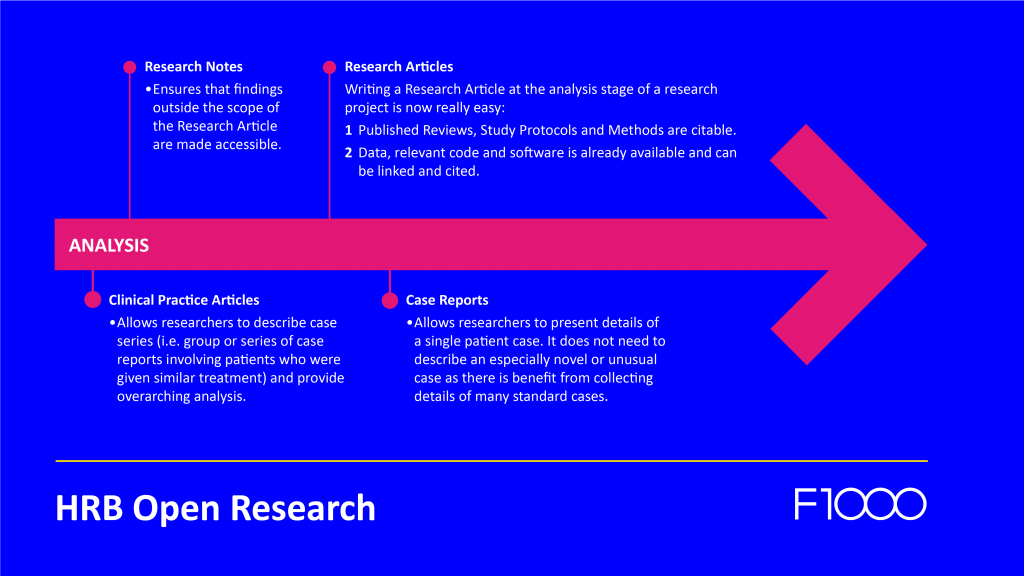
To support the final stages of a research project, a number of article types are available for different use cases.
Research Articles
The traditional Research Article remains a central output of any research journey, and an opportunity to present the final results of the project.
However, rather than focusing on novelty and impact of findings, as has historically been the case when publishing Research Articles, we welcome a range of results, including null and negative findings and reanalyses of previous studies.
The Research Article should also tie together all other published outputs thus far, with related Reviews, Study Protocols, Methods, Data Notes, and Software Tool Articles linked to the final article.
In doing so, this provides others in the research community with everything they may need to reproduce the study and build upon it in future research.
Previously published Research Articles:
- What influences a person’s willingness to share health information for both direct care and uses beyond direct care? Findings from a focus group study in Ireland
- Changes in the utilisation of acute hospital care in Ireland during the first wave of the COVID-19 pandemic in 2020
Research Notes
For anything that falls outside of the final scope of the Research Article, Research Notes can also be published in the analysis stage, which ensures these out-of-scope findings are still visible, citable, and accessible.
Previously published Research Notes:
- Turning their backs on the ‘ladder of success’? Unexpected responses to the MacArthur Scale of Subjective Social Status– published on Wellcome Open Research, another F1000 powered open access publishing Platform for Wellcome-funded researchers
Case Reports and Clinical Practice Articles
Similar to Research Articles, these article types provide an opportunity to present findings specifically designed for clinical study.
Case Reports allow researchers to present details of a single patient case, while Clinical Practice Articles are designed to present case series, i.e., a group or series of case reports involving patients who were given a similar treatment.
Again, while publishing these findings may have historically centred around novelty or impact, we welcome all cases.
Previously published Case Notes and Clinical Practice Articles:
- Recurrent internal hip rotation gait in cerebral palsy: Case reports of two patients
- Electroencephalography in a neonate with isolated sulfite oxidase deficiency – a case report and literature review
- Early Neonatal EEG in Two Infants with Pallister Killian Syndrome (PKS)
Publishing with HRB Open Research
We hope this blog series has provided insight into how you can maximise research outputs by publishing at every stage of a project.
For more information on each article type, you can find article guidelines here.
If you’re ready to submit your research, find out more about publishing with HRB Open Research here.