Maximising research outputs: publishing findings at the concept and planning stages
| 6 March, 2023 | Abbie nicholson |

Significant time and resources go into every research project, yet only a small fraction of this is reflected in the final Research Article.
We believe that it’s important for researchers to be able to publish and get credit for all the work and analysis that makes up a research project, with HRB Open Research supporting 11 different article types that can be published, indexed, and cited at each stage of the research journey.
We explored the importance of these non-traditional article types in the first blog of the series, and in the rest of the series, we’re looking at how each article type can be used at different stages of a research project – starting with the concept and planning phases.
Concept stage
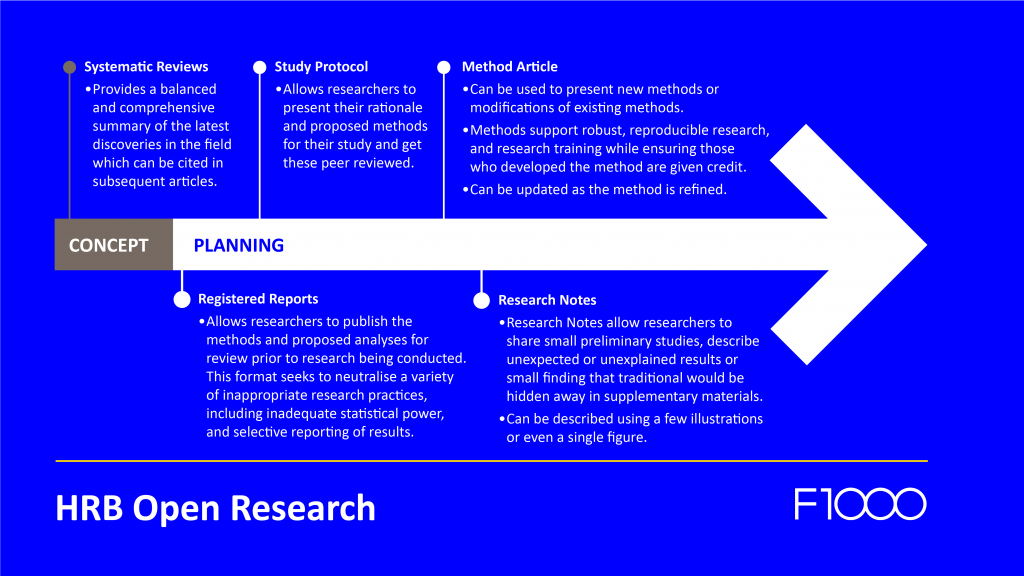
Systematic Reviews
Formulating a clear research question and reviewing related existing literature and discoveries is vital to any research project, allowing the conceptualisation of new work.
This takes a substantial amount of time and effort, requiring a comprehensive review and analysis of available material, while also ultimately providing a rich resource for others exploring similar questions.
To maximise the utility of this output for the wider research community, and ensure authors gain appropriate recognition for their work, researchers can publish their findings as a specific output through Systematic Reviews.
Previously published Systematic Reviews:
- Sedentary behaviour levels in adults with an intellectual disability: a systematic review and meta-analysis
- Physical functioning limitations and physical activity of people experiencing homelessness: A scoping review
Planning stage
There are a number of elements that go into the planning stage of a research project, and researchers can publish these outputs through a variety of article types.
Study Protocols and Registered Reports
Researchers can publish study designs for basic and applied research, systematic reviews, new methods, and more as Study Protocols, which has many benefits for authors.
Not only do Study Protocols provide greater visibility and potential for citations for study designs, they also allow experts in the field to provide valuable feedback via peer review.
This may provide useful ways to improve the project before it begins and subsequently help streamline the study. Study Protocols are the most popular article type on HRB Open Research and continue to be highly read and cited on the Platform.
Study Protocols can be published independently or as part of a Registered Report. This requires publication of a Study Protocol as phase one and the final Research Article as phase two, which is awarded a Registered Report badge after completing peer review.
Previously published Study Protocols:
- Comprehensive geriatric assessment in the emergency department: A protocol for a prospective cohort study
- Music and Movement for Health: Protocol for a pragmatic cluster-randomised feasibility pilot trial of an arts-based programme for the health and wellbeing of older adults
Method Articles
Method Articles can be published at multiple stages of the research project, with each publication building on its predecessor as methods evolve and are refined.
In the planning stages, Method Articles can present initial methods for a research project, whether they are new methods or modifications of existing methods.
Similar to Study Protocols, these give authors an opportunity to receive expert feedback from reviewers, helping to identify any potential issues with the proposed methods, while ensuring those who developed the method receive appropriate recognition and credit.
Previously published Method Articles:
- Linking death registration and survey data: Procedures and cohort profile for The Irish Longitudinal Study on Ageing (TILDA)
- Projecting future health and service use among older people in Ireland: an overview of a dynamic microsimulation model in The Irish Longitudinal Study on Ageing (TILDA)
Research Notes
As with Method Articles, Research Notes can be published across the research project, presenting new findings at each stage.
Publishing Research Notes at the planning stage allows researchers to share preliminary small studies or describe unexpected or unexplained small findings, which would be traditionally excluded from the final Research Article.
Previously published Research Notes:
- A concept analysis of ‘trial recruitment’ using the hybrid model
- The second wave: estimating the hidden asymptomatic prevalence of COVID-19 in Ireland as we plan for imminent immunisation
- Estimating the epidemiology of chronic Hepatitis B Virus (HBV) infection in the UK: what do we know and what are we missing? – published on Wellcome Open Research, another F1000 powered open access publishing Platform for Wellcome-funded researchers
Publishing with HRB Open Research
We hope this has provided some insight into how you can start to maximise your research by publishing outputs during the concept and planning stages of a project. In the next blog of the series, we’ll look at the different article types that can be published during the data collection and analysis stages.
For more information on each article type, you can find article guidelines here.
If you’re ready to submit your research, find out more about publishing with HRB Open Research here.