Looking back at 2022: a year in review at HRB Open Research
| 13 December, 2022 | Abbie nicholson |

As a year in which HRB Open Research continued going from strength to strength comes to a close, we’re reflecting on some of its biggest achievements in 2022.
We’re also recapping the five research papers that most resonated with readers over the last year, from COVID-19 findings to new software apps for use in cancer research – find out more below.
2022 in numbers
“Having HRB Open Research accepted for indexing in Scopus was a fantastic achievement for this year.
The decision means all articles that pass peer review on the Platform will benefit from even greater discoverability and readership and further highlights HRB Open Research’s strength in supporting the HRB research community.”
Hannah Wilson, F1000 Senior Associate Publisher
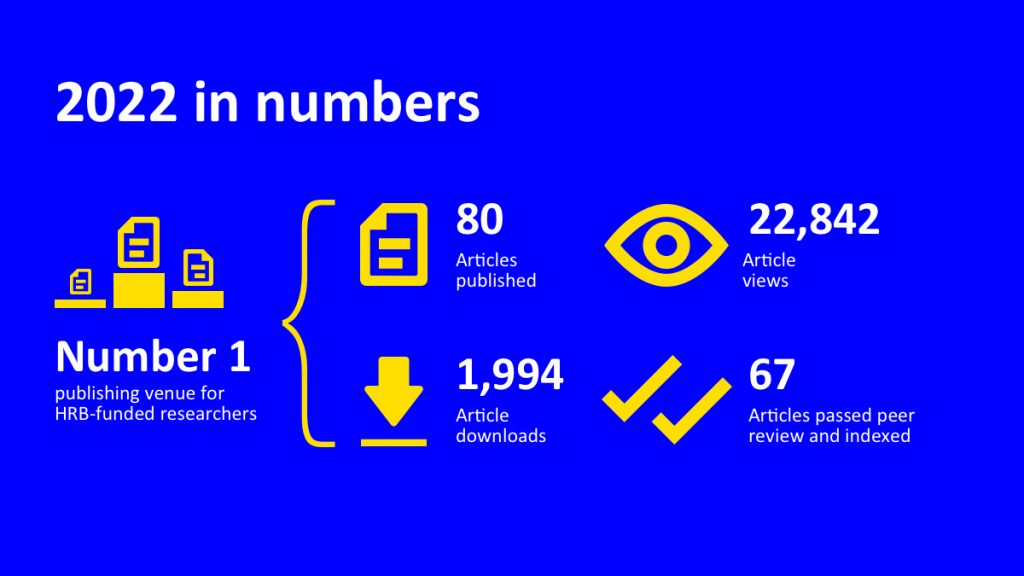
2022 was another great year for HRB Open Research, and it retained its spot as the most popular publishing venue for HRB-funded researchers.
At the time of writing, 80 articles had been published on the Platform this year, sharing insights across a range of medical and health sciences, from the role of paramedics in General Practice to the implementation of telemedicine in Ireland.
67 of these articles went on to pass peer review and be indexed in PubMed. Indexing in Scopus will follow, due to the acceptance of HRB Open Research for Scopus indexing earlier this year.
These articles published in 2022 accrued almost 23,000 views and almost 2,000 downloads, demonstrating the significant visibility of articles published on the Platform and the benefits for authors in reaching wider audiences when publishing open access.
The importance of different article types
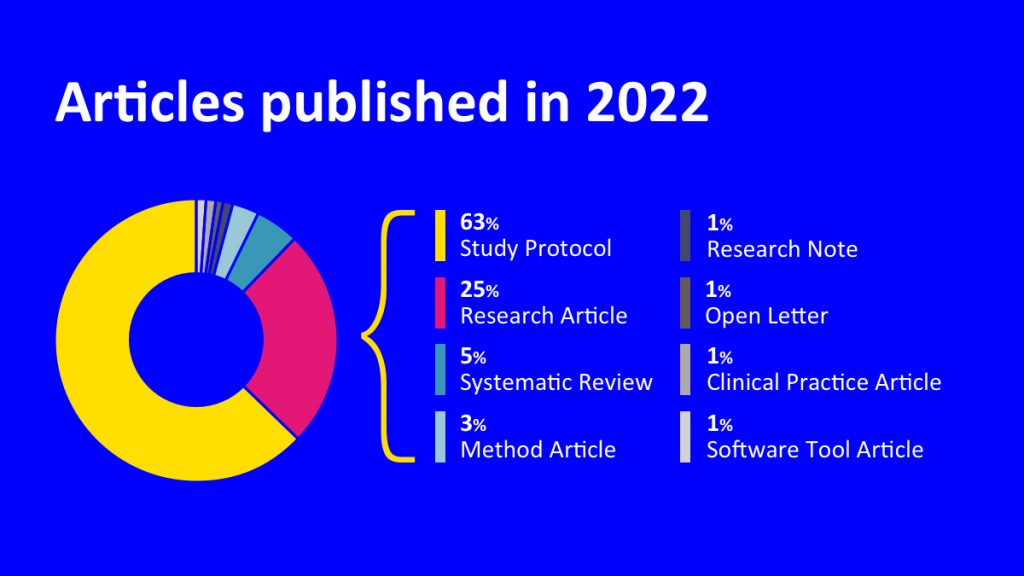
A key benefit of the HRB Open Research publishing model is the acceptance of different article types, from traditional Research Articles to Data Notes and Software Tool Articles.
This ensures that all research outputs can be published at different stages throughout the research journey, thus reducing research waste, while also enabling greater reproducibility and trust in the findings.
HRB Open Research is now well established as a venue for publication of Study Protocols, with 50 published so far in 2022. It was great to see seven other article types also published so far in 2022 – including four Systematic Reviews, and two Method Articles.
We explored the importance of different article types further in our blog.
2022’s five most-read articles
Articles published on HRB Open Research this year covered a range of research topics and themes. The five most-read are:
1) Impact of Long COVID-19 on health and quality of life
With the research community continuing to deepen its understanding of COVID-19 and how we can learn from it, it’s perhaps unsurprising that an article focussing on the long-term health implications of COVID-19 is the most-read of the year.
With 1,419 views since its publication in April, this Research Article aims to measure the impact of post-acute sequelae of COVID-19 on quality of life, mental health, ability to work, and return to baseline health in an Irish cohort.
Findings show that 38% of respondents reported that their ability to work is severely limited, and 33% reported a moderate or higher level of anxiety or depression.
This Research Article also garnered significant media attention in highlighting the long-term impacts of COVID-19, with coverage in both The Irish Independent and BBC News.
We explored the impact of COVID-19 on mental health in our blog.
2) GNOSIS: an R Shiny app supporting cancer genomics survival analysis with CBioPortal
Our second most-read article is a great example of the benefits of publishing diverse article types with HRB Open Research, and how publishing your algorithms, code, and software tools can boost the visibility of research.
This Software Tool Article has had 739 views in 2022 and outlines an innovative new app that can support clinician-researchers in cancer research by simplifying how they explore and visualise clinical and genomic data.
3) Quality care metrics for nurses working in general practice, mapping the evidence: a scoping review protocol
Our third most-read article sets out a method for reviewing a key topic of healthcare provision – the role of general practice nurses in continually developing healthcare settings.
The Study Protocol, which has received 540 views, aims to review how the role of Irish general practice nurses has developed and grown in response to changing policy, clinical and workforce demands, and how the development of nursing quality care process metrics (QCP-Ms) in general practice can help benchmark and improve the development of services.
4) Study Protocol for the St James’s Hospital, Tallaght University Hospital, Trinity College Dublin Allied Researchers’ (STTAR) Bioresource for COVID-19
Another COVID-19 research article is our fourth most-read article of 2022, with 503 views, again highlighting that COVID-19 remains high on the research agenda.
This Study Protocol explores the St James’s Hospital, Tallaght University Hospital, and Trinity College Dublin Allied Researchers’ (STTAR) COVID-19 biobank, and how it can help inform national and international strategy on health service provision and disease management related to COVID-19.
5) Enhancing the implementation of the Making Every Contact Count brief behavioural intervention programme in Ireland: protocol for the Making MECC Work research programme
With 482 views, our fifth most read article highlights how the HSE Making Every Contact Count (MECC) Programme can help target behavioural risk factors through brief behavioural interventions, such as physical activity, diet, smoking, and drug and alcohol use information, during routine consultations.
However, the Study Protocol also highlights that the MECC Programme needs effective and consistent implementation to achieve this and outlines the ‘Making MECC Work’ research programme, which seeks to develop an implantation strategy to optimise uptake in Ireland.
Looking to the future
We want to take this opportunity to thank all the authors and peer reviewers who have published and reviewed with HRB Open Research this year.
We look forward to seeing more cutting-edge research published in 2023, and learning where the research agenda goes next, especially post-pandemic.
If you’re new to HRB Open Research and would like to learn more or are just looking for more information on the Platform and how it works, visit our website.