Methods, data, and code: how diverse article types can help reduce research waste and boost real-world impact
| 1 December, 2022 | Abbie nicholson |

Traditional scholarly publishing models, and wider academia, have long placed singular importance on the Research Article – the final paper published at the end of a research project, considered to be the pinnacle of any investigation. As a result, these Research Articles make up the bulk of published work in journals of all disciplines, including healthcare delivery and clinical research.
The esteem in which Research Articles are held is certainly warranted, and Research Articles continue to play a vital role in the research journey. However, this singular focus on the final paper can undermine the value of other, less traditional research outputs, leading to research waste and lower research visibility.
In this blog, we explore why it’s important to widen this focus to all research outputs, and some of the diverse article types supported by HRB Open Research.
Non-traditional research article types
HRB Open Research’s innovative publishing model differs in many ways from traditional publishers, including its much broader scope.
This allows HRB-funded researchers to publish all results they feel are worth sharing and, as a result, the Platform supports a wide range of non-traditional article types to ensure findings can be published at any stage throughout the research journey.
Some of these non-traditional article types include:
- Study Protocols, which describe in detail any study design, including (but not limited to) exploratory, translational or applied biomedical research, clinical and epidemiologic studies, clinical trials, health services or population health sciences research, or the outcomes of research projects in social sciences and humanities.
- Software Tool Articles, which describe new software tools or code and the rationale for development.
- Data Notes, which provide brief descriptions of scientific datasets that promote the potential reuse of the data.
- Clinical Practice Articles, which describe a series of cases wherein a group of patients were given similar treatment.
This shift from focusing solely on Research Articles to a variety of other elements of the research project significantly widens the scope of publishable work and highlights the value of non-traditional research outputs.
You can find a full overview of all the different article types supported by HRB Open Research and their different uses in the image below.
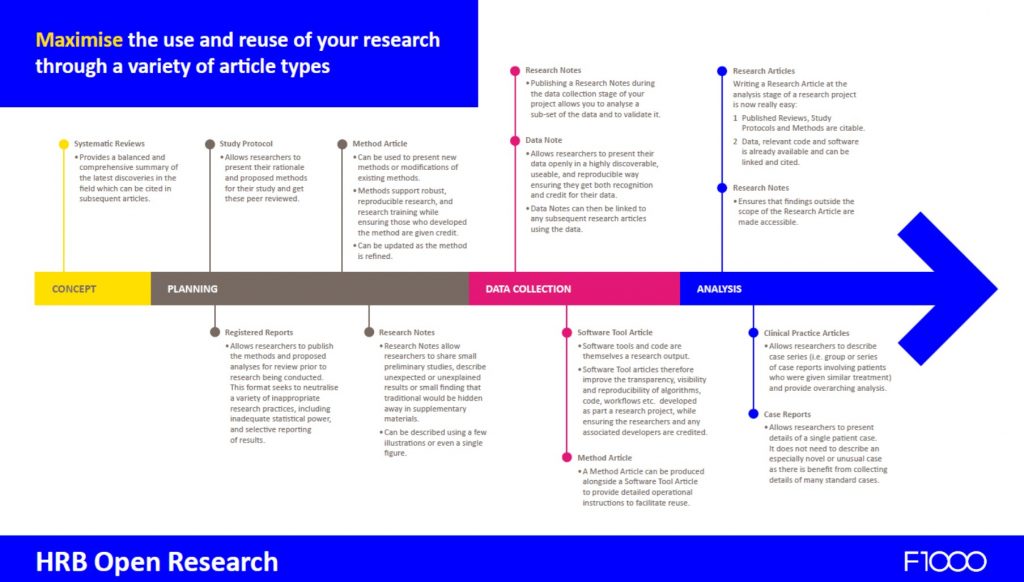
The importance of diverse article types
So why is it important to recognise the value of these other article types?
Reduction of research waste
One of the principal benefits of publishing more diverse article types is the reduction in research waste.
A huge amount of investigation, data, and analysis goes into every stage of a research project, but only a very small snapshot of this is incorporated into the final paper. As a result, much of this vital work is moved to the sidelines, archived, and, arguably, wasted.
However, the ability to publish all of this background work as a different article type at every stage of the research project, from methods and data to initial findings reports, reduces this waste and ensures all research activity is recognised.
Similarly, publishing outputs at each stage, rather than just the final stage, can help reduce research waste by streamlining time and effort.
Every article type on HRB Open Research is peer reviewed by experts, which means peer review can help improve a research project as it takes place to minimise any issues that may arise in future. Furthermore, other researchers can build on the foundations laid at each of these different stages to help reduce repetition of research and accelerate the speed of their own discoveries.
More in-depth analysis and feedback
Tied to this reduction in research waste is the ability to present and analyse findings in much more depth than in a traditional Research Article.
Final project papers often include relatively small sections for methods, data, software, or study or case design and, as we’ve mentioned already, much of the work that has been collated and analysed throughout the project is then cut down to a snapshot.
The ability to publish these elements as dedicated, standalone articles allows for much deeper analysis and discussion within the article, and subsequently much richer feedback from readers and reviewers through a more comprehensive understanding of the work.
Greater reproducibility and trust
Not only does providing access to all elements of the research project result in richer peer review, it also enables greater reproducibility.
By providing access to all elements of the research at each stage, including comprehensive information within dedicated articles for things like data and software, other scientists and wider stakeholders can reproduce the research step-by-step much more easily.
As a result, other researchers can come to the same conclusions and corroborate the findings, which in turn helps to build trust in the results and wider research.
Increased research visibility
An important result of publishing different article types at different stages of a research project is a significant increase in visibility, not only of the research itself but also of the researchers involved.
Each article published on HRB Open Research has a DOI and is indexed in industry databases such as Scopus and PubMed when it passes peer review. As a result, these articles are all discoverable, which means research projects could be discovered in multiple ways through different article types, as opposed to just one way with the final paper.
In turn, the capacity for citations is increased, with each article immediately citable upon its publication.
It can also boost overall real-world impact of research, as multiple articles can increase the chance of research being discovered and used by stakeholders outside of the research community, including policymakers.
Diverse research article types in practice
We’ve highlighted a snapshot of some of the diverse article types published on HRB Open Research below.
This Study Protocol sets out a study design to examine teaching strategies being implemented by nurse educators to encourage the development of interpersonal and communication skills in facilitating positive interpersonal relationships between the preceptor, nursing student and patient.
2,017 views and 179 downloads.
Improving palliative care with machine learning and routine data: a rapid review
This Systematic Review examines current scientific evidence to understand how machine learning can help improve clinical decision-making and policy design.
1,124 views and 109 downloads.
GNOSIS: an R Shiny app supporting cancer genomics survival analysis with cBioPortal
This Software Tool Article illustrates how GNOSIS: an R Shiny app supports clinician-researchers by helping them explore and visualize clinical and genomic data, which can aid supporting cancer research.
697 views and 42 downloads.
You can find out more about this Software Tool in our interview with the author.
Publishing diverse research articles with HRB Open Research
If you’re a HRB-funded researcher who would like to improve your research visibility and boost real-world impact of your work, you can publish your findings today with HRB Open Research at every stage of your research journey.
Find out more about the diverse article types in our article guidelines, and submit your research for publication via the Platform.