The possible influence of lutein and zeaxanthin on the cognitive performance in children
| 17 February, 2020 | Ekaterina Loskutova & James Loughman |

‘A veritable tour de force’, was how reviewer, Jim Stringham, University of Georgia, US, described research by Ekaterina Loskutova and James Loughmam, Technological University Dublin, Ireland. In this blog, they discuss their research on lutein and zeaxanthin, and the influence these carotenoids have on children’s brain development. The article is published in the Maternal and Child Health gateway on HRB Open Research.
Lutein and zeaxanthin are dietary carotenoids, which preferentially accumulate in neural tissue, including the central region of the retina (macula), where they form macular pigment, and in several specific regions in the brain (the frontal, occipital and temporal cortices, hippocampus and cerebellum). These carotenoids have been studied extensively for their role in eye health and in the prevention of retinal disease, such as age-related macular degeneration and glaucoma.
Eye health and vision
Lutein and zeaxanthin exhibit blue light-filtering, antioxidant, anti-inflammatory and neuroprotective properties, which are believed to benefit eye health and vision. Other than blue light filtration, these properties may also support and optimise cognitive function, potentially slowing down cognitive decline associated with ageing.
So far, the beneficial effects of lutein and zeaxanthin have been primarily studied in relation to older age, as oxidative stress and inflammation have been implicated as pivotal components of age-related visual and cognitive decline.

The infant brain
Lutein and zeaxanthin accumulate in neural tissue even before birth, being passed to the foetus via the placenta during gestational development in the womb. Lutein and zeaxanthin are present in the eye from 18 weeks of pre-natal development, while in the brain they have also been found in preterm infants, suggesting that they have an important biological role for early neural development and maturation.
Additionally, the relative contribution of lutein to total carotenoids is almost two-fold greater in the infant brain than in adults, accounting for 59% vs. 34%, respectively. Such selective concentration of lutein and the multitude of effects these carotenoids have on neural cell viability suggests that these compounds may play a key role in the early processes of neural and hence cognitive development in children.
Dietary requirements
In humans, lutein and zeaxanthin cannot be produced endogenously and are, therefore, acquired entirely from dietary sources. Breast milk provides an excellent source of bioavailable carotenoids before children begin to consume solid food sources themselves (formula feed has much poorer lutein bioavailability than breastmilk). Green leafy vegetables, yellow peppers, corn and eggs are some of the best sources of these carotenoids once a child progresses to solid food.
An influence on brain development
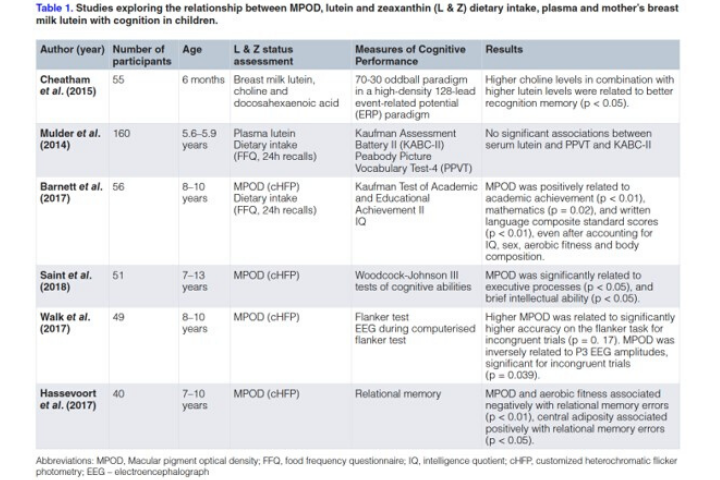
The evidence concerning the effect of lutein and zeaxanthin on cognition in children is relatively sparse. However, there are findings of positive associations between levels of breast milk lutein, plasma lutein, macular pigment levels in the eye and cognitive abilities in children.
The associations extend across numerous cognitive domains, including better academic achievement, better recognition memory, executive function and reaction time (see Table 1). Collectively, these provide some initial evidence for the role of lutein and zeaxanthin in cognitive development. Although, not yet supported by intervention trials, these findings highlight the importance of habitual intake of lutein and zeaxanthin in children.
Potential deficit
Lutein and zeaxanthin intake levels during the important developmental stages of childhood appears to be highly variable and potentially deficient. At the same time, there is accumulating evidence to suggest that lutein and zeaxanthin may play an important role for cognitive development and maturation in children, meriting adoption of recommended daily/dietary allowances for these phytonutrients.
Choosing openness and transparency
HRB Open Research platform has several advantages, including free publishing for HRB-funded researchers, open access publishing model and, importantly, rapid publishing. One of the features that appealed to me most was the transparency of the review and publishing process.
Open peer review, i.e. publishing reviewer’s comments along with an article, is an exciting new publishing model. It increases transparency in the review and publishing process, reduces the possibility of biased reviews, gives the due credit to the reviewers’ work, as well as raising the standards for both the researchers and the reviewers. The professionalism of the editorial team added to the streamlined publication process making for a very pleasant experience.