All in all it’s been a pretty good year – highlights for 2019
| 17 December, 2019 | Charlie Vickers |

As the year draws to a close, Charlie Vickers, Senior Editorial Assistant, shares noteworthy moments from 2019. We would also like to take this opportunity to thank all our authors and reviewers who have contributed to HRB Open Research’s success. We wish you all the best for the holiday season and a Happy New Year! So, without further ado, here are the year’s highlights.
The end of 2019 is fast approaching, so the editorial team here at HRB Open Research have had a little look at a couple of the most noteworthy things to happen on the platform this year. It was hard to pick specific highlights, with 36 articles published in 2019 alone, with 16 undergoing the peer review process and 20 passing peer review!
All things new
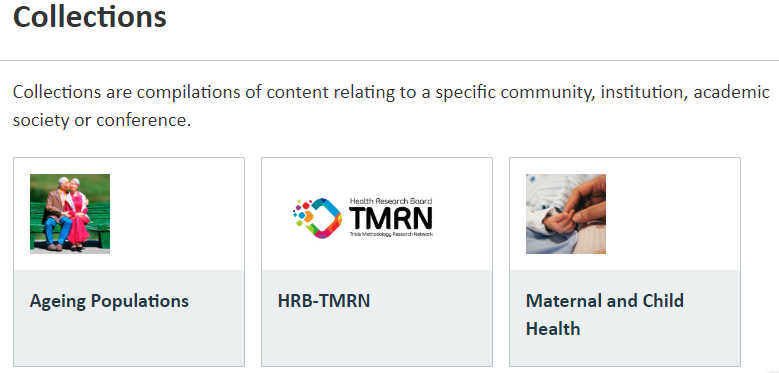
One of the most important things to happen this year has been the launch of our first collections, which are compilations of articles relating to a specific area of research. We launched with an initial two Aging Populations and HRB-TMRN. These proved a success, with 14 articles across these two collections. We then launched the Maternal and Child Health collection, which has 9 articles alone. As we move into the next year, we are keen to set up more collections, to showcase the breadth of the research HRB is funding.
Away from the articles in our new collections, we have also launched a new article type, the Registered Report, which are a cross publisher initiative to attempt to remove a number of questionable research practices. More information can be found on this F1000Research blog post.
Registered reports are split into two stages, the first being a Study Protocol. This year, our first stage 1 Study Protocol was published, authored by Attracta Lafferty, and it has already passed peer review, receiving two Approved peer review reports. The next step of a Registered Report is to undertake the research as described in Stage 1 and turn this into a Research article, known as Stage 2. We have also published our second Stage 1 and look forward to publishing the next stage(s).
Diversity
As well as these new ventures, we have continued to provide an opportunity for early career researchers to publish their research, highlighted by the fact that seven of our published papers have come from HRB’s Sphere Grant program, which aims to train population health and health service researchers from across the spectrum of disciplines.
As well as priding ourselves on the opportunities we provide for researchers who are just beginning their career path, we also believe it’s important to promote equality in science – 64% of our authors in 2019 were female, alongside 60% of our reviewers. This was performed using the R Gender package, to determine the probability of a name being male or female. Those with less than 70% certainty were determined manually.
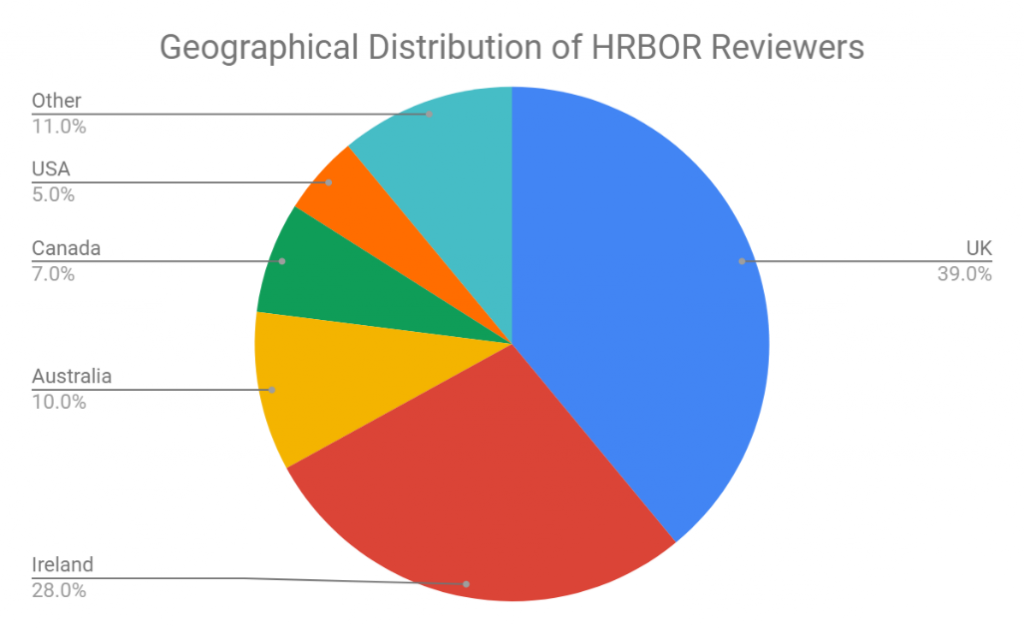
However, we do realise there is a bias to the global north for our reviewers, as seen in Figure 1, and we are continuing to encourage authors to suggest reviewers from across the globe. Not only will this achieve a more complete peer review experience for our articles, but it also ensures the high quality research published on HRB Open Research has international reach.
Fig 1: Geographical distribution of HRB Open Research reviewers.
Our reviewers contributed 120 peer review reports this year, of which 12% were co-reviewed. A great example of this can be seen in this review by Motohide Miyahara and Tessa Pocock, which highlights our commitment to also provide an opportunity to those early in the research careers to be part of the peer review process.
Our article highlights
Owing to our post-publication peer review model, articles can be available online much quicker than with traditional journals. A great example of this is the article by Marita Hennessy and colleagues, which after being submitted in July and passing our internal checks, was published in 6 days and had already passed peer review by September – a speedy 65 days from submission to the initial completion of the process! As HRB Open Research allows versioning, Marita chose to submit and publish a new version, to ensure any points raised by the reviewers were fully clarified.
Another article which passed peer review in September was by Julie Broderick et al, which received 3 peer review reports, 2 Approved and 1 Approved with reservations. It was the latter report, by Serena Luchenski and Luke Johnson, that was the longest peer review report published on HRB Open Research in 2019. As well as being the longest report, it also stood out for its quality, with its clear structure and in-depth comments.
The quality of our peer review
The quality of our peer review is another thing we pride ourselves on, with our transparent model ensuring that reviewers will submit detailed reports to us, even when approving an article.
One example of a good peer review report we published this year was by Cindy Mann, from the University of Bristol. As with the other report mentioned so far, the layout is important, making it clear to both authors and readers the areas of the article they wish to be expanded or clarified.
Sometimes, the peer review process can be even quicker than for Marita Hennessy, as shown by this article authored by Eamon O’Shea. Having been published on 1st February, it had received 2 reports with a status of Approved by 12th February, making it the quickest article to pass peer review on HRB Open Research in 2019.
Next year and beyond
After reflecting on our work this year, we’re looking forward to 2020 and beyond, working alongside early career researchers, improving the diversity of our reviewer pool, establishing further collections and continuing to publish high quality research funded by HRB!