Happy Birthday – celebrating our first year
| 28 February, 2019 | Patricia Clarke |

HRB Open Research launched one year ago today, and what a year it’s been since it launched. We reflect on the journey so far and look forward to what the future holds as we enter our second year.
A very happy birthday to us! HRB Open Research celebrates its commitment to open science and recognises the many achievements in its first year of publishing.
A game changer for Ireland
HRB Open Research provides a place for all Health Research Board funded researchers to rapidly publish any results they think are worth sharing. When we launched, we called on researchers to stand up for research quality and use the system we built.
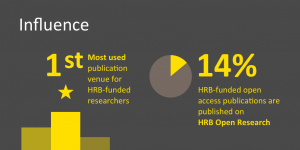
One year into our open research journey and we’re proud that HRB Open Research is the most used publication venue for HRB-funded researchers*. We’re also delighted to see so many researchers submitting their articles to this new publishing model. So far, 222 authors have now published with us, and we hope many more will submit.
When browsing the articles you can see we deliver both quality and openness, showing that one doesn’t have to be at the cost of the other, and are a fruitful pairing.
Gemma Irvine, Head of Policy and Strategic Planning, Higher Education Authority is on the National Steering Group, explains how it helps early career researchers: “The HRB Open Research Platform is a game-changer for Ireland. It is an excellent example of an innovative way to increase the reach and visibility of researchers’ work while still being subject to rigorous peer review and the highest academic standards. We are moving away from a focus on where research output is published to a focus on the activity that follows the publication of the research, for example citations and the impact on the research area. This can only be a good thing for the career development of early stage researchers who often find it hard to break into the established networks of traditional publication outlets.”
The numbers speak for themselves
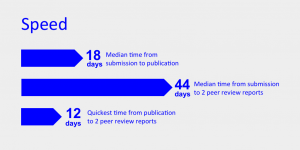
Our infographic highlights some of the key numbers that represent our achievements to-date (see full version at the end of the blog).
One of the major benefits of our model is the rapid publication and article processing times. On average it takes 18 days from submission to publication, and 44 days from submission to two peer reviews. 12 days is the quickest time from publication to two peer review reports.
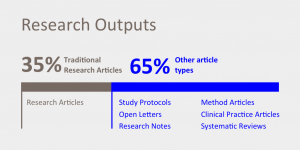
We enable researchers to share findings through a wide range of different article types, including study protocols, open letters, research notes, method articles, clinical practice articles and systematic reviews. These different article types allow researchers to get credit for the range of different research outputs they are producing, so we’re pleased that they are proving popular- 65% of the articles published on the platform are non-traditional.
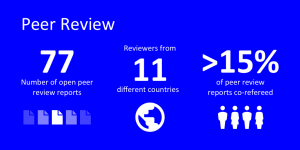
Among the total of 77 open peer review reports, we have reviewers from 11 different countries including Brazil, USA, Indonesia, Netherlands and Thailand. More than 15% of the reviews are co-refereed, something we highly encourage, as supervisors co-signing with junior researchers not only provides a valuable training tool in peer review, but grants junior researchers the credibility and visibility they deserve.
The articles have been viewed a total of 20271 times and downloaded 2366 times.
Embracing open research
Our open research publishing model enables researchers to communicate and disseminate research to a wider audience; increase the value of their work and reduce research waste. We invited authors who have published on HRB Open Research to share their thoughts about the platform and the benefits of open science. Here are their responses:
Marita Hennessy, National University Ireland Galway, published an open letter, calling for researchers and others to be transparent about conflicts of interest in public health research to manage concerns about interactions with commercial food and drink companies: “I published my open letter on HRB Open Research as it enabled my colleagues and I to share our work openly, immediately, and with a broad community. This was important as we wanted to generate debate and discussion through our open letter which advocates for complete transparency in public health nutrition research. The timely publication on HRB Open Research enabled us to get ahead of the curve.
HRB Open Research allows me to share my work openly and immediately, and receive constructive feedback from peers within a short time-frame, which is beneficial as an early career researcher as it keeps you motivated and engaged in the process.”
Thinking about ways of improving how we manage and interpret ‘big data’, Brian Reddy, National University Ireland Galway, wrote a method article covering data linkage in medicine to combine clinical and environmental/weather data: “HRB Open Research has the potential to play a meaningful role in transforming how scientific papers are published. Its commitment to open data – and transparency in general – is laudable. The fact that papers are made openly available at no cost to the author is as it should be (but for some reason is too rarely the case). It also has a remarkably quick turnaround time between submission and publication. So far it seems to be doing an awful lot right – keep it up!”
In a study protocol, Elaine Toomey, National University of Ireland Galway, addresses fidelity within complex health behaviour change interventions to create practical guidance for researchers using frameworks and models: “I published my article on HRB Open Research because I am passionate about Open Science and believe that platforms such as this are a crucial step in making science open and available for all to benefit from. I also published it there because of the ease involved in the submission process and the quick turnaround, enabling me to get my work out rapidly.
Publishing on platforms like the HRB Open Research platform are vital to ensure equitable and immediate access to research. Thinking about the bigger picture, I think that the gains to be made from publishing in this way, in terms of maximising research efficiency, reach and potential impact of our work as health researchers, are tremendous.”
Next Steps

We hope to continue to see the platform grow and gain popularity with HRB funded researchers, especially as our published articles continue to make an impact.
We’ve now launched Registered Reports as an article type on the platform to further encourage researchers to adopt openness and transparency.
The two-stage approach of Registered Reports enhances the credibility of your work, reduces publication bias, while gaining the additional benefits of increased transparency and reproducibility.
Focus is shifted on the research questions and the quality of the methodology rather than the results alone. The two-stage process means that the study protocol is published and peer reviewed prior to data collection (this is stage 1). So, your study methodology is assessed and you receive constructive feedback before proceeding to the next stage and carrying out your study. Once completed, the full research article (stage 2) is published along with the results and linked to the Stage 1 study protocol.
We hope this inspires you to adopt this process. You can read more about this article format in this blog and see our author guidelines to start submitting.
*Data gathered from Web of Science on 12.02.19.
